Highscore Games
Give yourself a score to beat
The first number you put up is a baseline. You can use it to find out whether a different route, a better launch, or an extra moment of concentration makes any difference. The Highscore page brings together several ways to chase that improvement. Some runs end when your reflexes give out. Others go better when you take a moment to see what is going wrong. Pick a game whose first attempt sounds enjoyable on its own, then give yourself a concrete reason to start it again. A small change you can observe is more satisfying than promising yourself a perfect run.
Decide which coins to leave behind
Highway Rush sends you down a busy road where oncoming traffic competes for your attention with collectible coins. On an early run, see how long you last when you move only to avoid cars. Add the coins back into your decisions and notice which detours create the biggest problems. A pickup right in front of you may cost more room than one you spot several car lengths ahead. If you are repeatedly boxed in, start checking the space beyond the coin before moving over to get it. You will get a better sense of which pickups fit the route you were already taking.
Find a launch you can repeat
Chicken Yeet sends a chicken on a trip toward space with help from an enthusiastic farmer. The absurd flight is fun to watch, but the launch itself is worth studying. Try to remember the moment you acted on a good attempt. On the next launch, see whether you can do it again before looking for a further improvement. Two results close together give you something firmer to work from than one spectacular flight you cannot explain. This makes a distance chase feel like a little experiment, even when the thing you are sending skyward is a chicken.
Keep a steady rhythm with one button
Orbit Ring 2 uses a single button for a game built around chasing a high score. There are few controls to remember, so your attention goes straight to the timing. If you tend to lose the rhythm after a successful sequence, pick out the moment you are responding to on screen. Use that cue again when you restart. After a few tries, you may notice that some presses come from a clear decision while others come from anticipating a problem that has yet to arrive.
Make your arithmetic more reliable
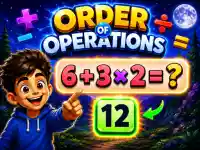
Order of Operation Challenge asks you to solve expressions using the order of operations. Read the full expression once and find the parentheses or powers before starting the calculation. If you make a mistake, see whether you picked the wrong operation or performed the right one incorrectly. Those errors call for different kinds of practice. Try keeping the steps in the same mental order for several expressions in a row. It gives you a routine you can rely on when an unfamiliar expression tempts you to start calculating at the first number you see.